Essays in Ottoman and Turkish History, 1774-1923 by Roderic H. Davison
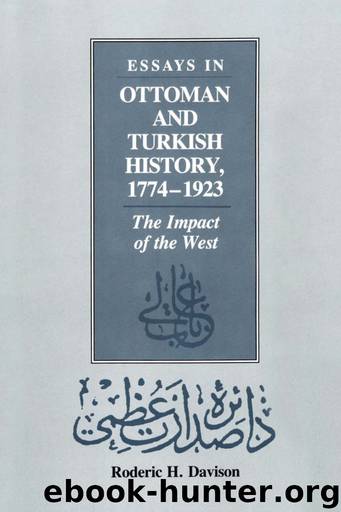
Author:Roderic H. Davison [Davison, Roderic H.]
Language: eng
Format: epub
Publisher: University of Texas Press
Published: 1990-04-10T04:00:00+00:00
9. Westernized Education in Ottoman Turkey*
In the early nineteenth century, when the reforming Sultan Mahmud II put his civil officials into Western trousers and frock coats and red fezzes, the members of the ulema retained the traditional robe and turban. This may have been due to the intercession of Keçecizade Izzet, the molla of Galata, who is said to have convinced the Sultan that, in the eyes of the people, “justice resided in the turban.”1 Later in the same century Europeans in Istanbul found that, when in the summer they wrapped white cloth around their straw hats as protection against the heat, the common Turk suddenly became deferential, and regarded them as okumuş—well read or well educated.2 Learning also, it seemed, resided in the turban.
The facts were, however, at variance with the popular attitude. The educational system which produced the learned men of Islam had fallen on evil days. The quality of the medrese—the higher school of Islamic education—had declined sharply since the sixteenth century.3 No longer did the ulema have even the good classical liberal education. There were, of course, exceptions. Some members of the ulema such as Cevdet Paşa were quite well educated, but much of this was self-education. Cevdet himself, though he defended some members of the ulema for their wisdom, did not hesitate to condemn others as ignorant.4 In general the ulema knew little about their own empire; about the surrounding world their ignorance was vast. There was certainly nothing in Islam that enjoined ignorance. Quite to the contrary, Islamic civilization in earlier days had produced fine schools, good scholarship in various fields of learning, and had borrowed widely from other cultures. “Seek knowledge even in China” was generally considered one of the sayings of the prophet Muḥammad. But pride, suspicion, lethargy, fear of contact with the infidel, all had contributed to the stagnation of education.
The ulema were not only the judges and juriconsults of the Ottoman Empire, but its teachers as well, and their ignorance affected others. What they gave their pupils in the mekteb, or grammar school, could hardly pass for proper education in the world of the nineteenth century.5 Most Turks grew up without any sound knowledge of their Islamic past, of their Turkish past, or of the world around them. When the elder Moltke first went as military adviser to the Ottoman Empire in the 1830’s he found there “educated” officials who only out of courtesy accepted his opinion that the earth was round.6 The learning of Islam was forgotten, the learning of the modern West not yet acquired. Western languages were known to almost no Turk. It was symptomatic that when in the 1820’s distrust of rebel Greeks forced the Turks to look to their own people for official interpreters, the first one was Bulgaroğlu Yahya Naci Efendi, a Bulgar converted from Greek Orthodoxy to Islam, and the second Hoca İshak Efendi, a Jew converted to Islam.
Into this Muslim Turkish society came Western educational influences, beginning in a trickle in the later eighteenth century, and growing into a flood by the early twentieth.
Download
This site does not store any files on its server. We only index and link to content provided by other sites. Please contact the content providers to delete copyright contents if any and email us, we'll remove relevant links or contents immediately.
The Vikings: Conquering England, France, and Ireland by Wernick Robert(81097)
Ali Pasha, Lion of Ioannina by Eugenia Russell & Eugenia Russell(40237)
The Conquerors (The Winning of America Series Book 3) by Eckert Allan W(37379)
The Vikings: Discoverers of a New World by Wernick Robert(36964)
Cecilia; Or, Memoirs of an Heiress — Volume 1 by Fanny Burney(32536)
Cecilia; Or, Memoirs of an Heiress — Volume 2 by Fanny Burney(31934)
Cecilia; Or, Memoirs of an Heiress — Volume 3 by Fanny Burney(31925)
Empire of the Sikhs by Patwant Singh(23066)
The Secret History by Donna Tartt(19025)
Hans Sturm: A Soldier's Odyssey on the Eastern Front by Gordon Williamson(18564)
Cat's cradle by Kurt Vonnegut(15324)
Pimp by Iceberg Slim(14476)
Sapiens: A Brief History of Humankind by Yuval Noah Harari(14358)
Talking to Strangers by Malcolm Gladwell(13340)
Norse Mythology by Gaiman Neil(13332)
Leonardo da Vinci by Walter Isaacson(13304)
4 3 2 1: A Novel by Paul Auster(12363)
Underground: A Human History of the Worlds Beneath Our Feet by Will Hunt(12080)
The Radium Girls by Kate Moore(12012)
